
09 / AI PROJECT CONCEPT
AutomateOS
Automations teams can inspect and trust.
AutomateOS: Observable AI Workflow and Integration Studio
The Problem
Automations tend to become fragile when logic is spread across scripts, webhooks and undocumented integrations. Adding an AI step can make behavior harder to explain unless inputs, outputs, confidence and fallbacks are visible. Teams need to know what ran, where it failed, whether a retry is safe and which actions require approval.
The Solution
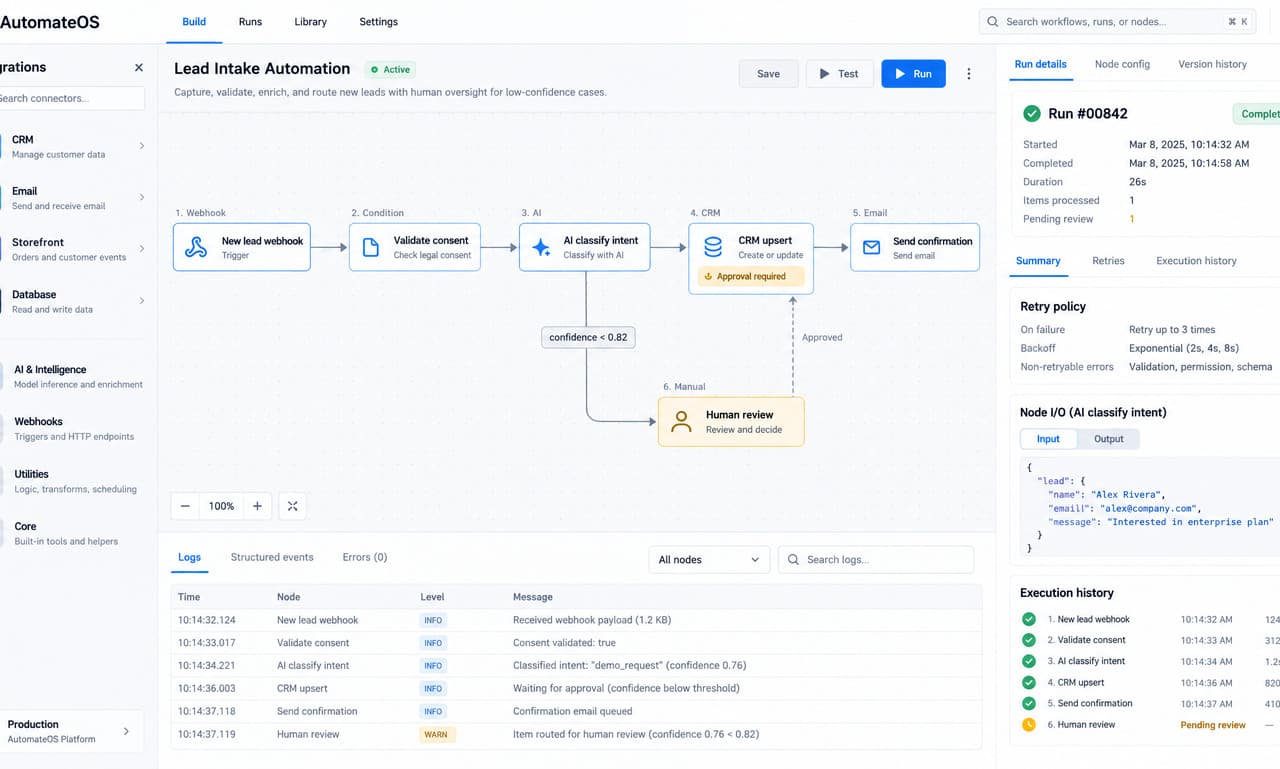
AutomateOS is a product concept for a visual workflow canvas combined with a detailed execution inspector. Builders compose triggers, conditions, AI processing and application actions. Each run records typed inputs and outputs, timing, status and retry history. Human approval can pause a workflow before a consequential action; AI is one bounded node among deterministic integration and branching steps, not an invisible autonomous agent.
Key Features
Visual workflow canvas
Arrange nodes with explicit directional connections and branch conditions.
Integration catalog
Configure connectors using least-privilege credentials and clear scopes.
AI processing node
Apply a bounded classification, extraction or generation task.
Approval and fallback gates
Pause for human review or route uncertain outputs to a safe branch.
Execution history
Search runs by workflow, status, time and correlation ID.
Retry and error controls
Distinguish transient failures from invalid data and prevent unsafe duplicate actions.
Workflow health
Monitor queue depth, error patterns and connector status.
Architecture
Proposed architecture: React/TypeScript canvas client; workflow definition API with versioned JSON graph schemas; durable execution engine backed by PostgreSQL and a queue; worker processes for webhook triggers and connector actions; encrypted credential vault; and an AI gateway with typed input/output contracts. Each execution should persist a trace ID, node status and redacted logs. Use per-tenant workflow storage, scoped integration credentials, approval records and a kill/pause control. High-volume executions can be partitioned by tenant and workflow with back-pressure.
AI Implementation
AI nodes can classify text, extract structured fields, summarize records or draft content. JSON-schema validation, business rules and explicit conditions determine whether the output proceeds. AI must not choose arbitrary connectors or bypass approval rules. Deterministic nodes handle authentication, branching, data transformation, idempotency and external actions. Evaluation suites should test expected outputs and failure cases before publishing a workflow version.
Example Workflow
An inbound lead webhook starts a run. A validation node checks required fields and communication consent. A bounded AI node classifies the enquiry into an approved intent set. A confidence condition routes uncertain cases to human review. High-confidence results prepare a CRM upsert, but a reviewer approves the write in the displayed concept. A confirmation message is then sent through a configured connector. The run inspector shows each node’s status, timestamps, redacted inputs, output schema and retry history.
Security & Privacy
Use tenant isolation for definitions, runs and secrets; store credentials in a managed vault; validate webhook signatures; and enforce connector scopes per workflow. Record immutable approval and action events, redact sensitive payloads and define execution retention. Prevent duplicate side effects with idempotency keys and safe retry policies. Support workflow pause, version rollback, rate limits, execution quotas and alerting. Connector actions should be tested in sandbox environments before production use.
Business Value
The intended value is maintainable automation with better visibility into behavior and failure states. Teams can identify the exact step requiring attention, retry safe transient failures and insert human checks where policy requires them. No run-volume, reliability or cost claims are made.
Challenges & Approach
Anticipated challenges include schema evolution, connector outages, duplicate events, long-running workflows, secret rotation and nondeterministic AI output. The proposed engine uses versioned definitions, durable queues, typed node contracts, correlation IDs, bounded retries and human gates for sensitive actions.
Next Steps
Choose one end-to-end workflow with a clear owner; document input/output contracts and failure modes; build a test harness with expected node results; validate idempotency and rollback behavior against sandbox connectors; then pilot with approvals and observability enabled.
Let's discuss your AI project
Thinking about a similar system? We can help you design, validate and build it.