
05 / AI PROJECT CONCEPT
CommercePilot AI
Support with the order context in view.
AI Support for E-commerce Orders, Email and Messaging
The Problem
Support agents switch between a conversation, order management system, carrier updates, product catalog and return policy. Copying details by hand slows routine responses and increases the chance of citing stale order information. Order changes, refunds and private customer data must only be accessed through explicit permissions and tested integrations.
The Solution
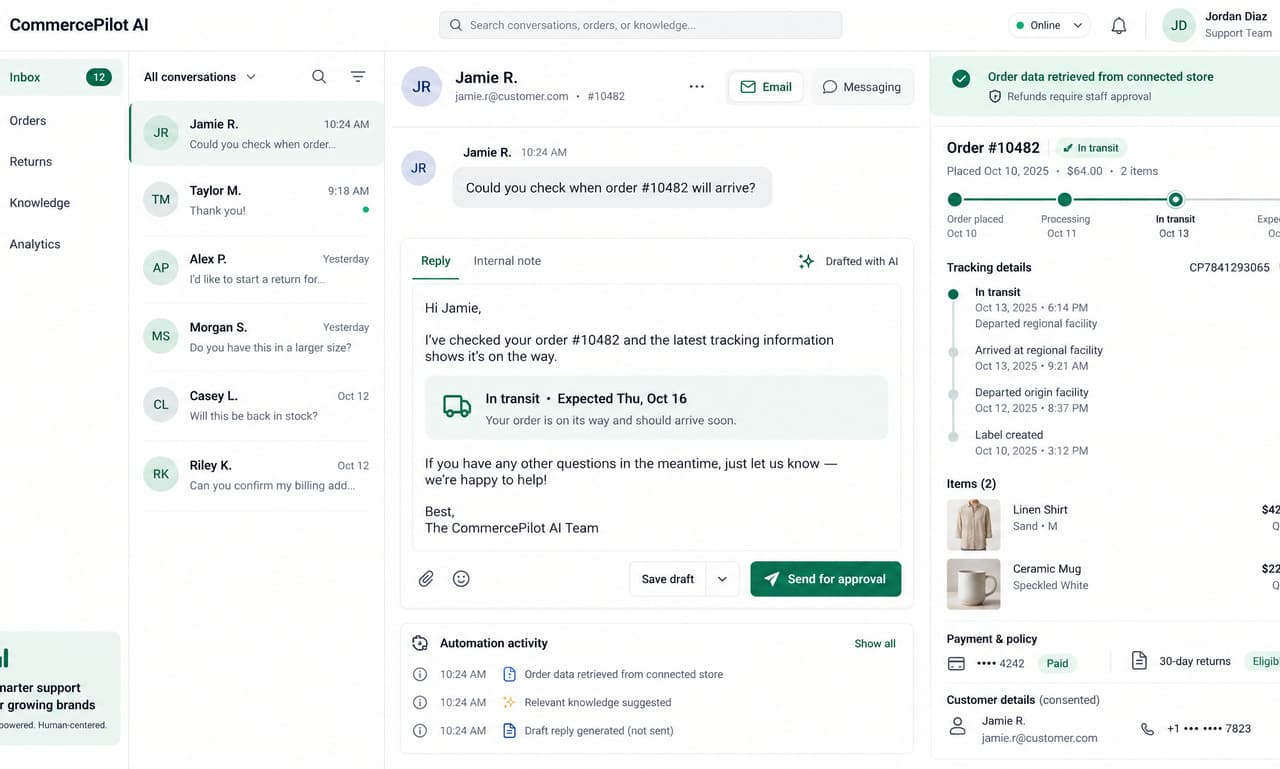
CommercePilot AI is a proposed split-pane support workspace connecting a conversation to authorized store context. The agent can see an order timeline and relevant product details while reviewing an AI-drafted response. Order lookup is read-only in the initial concept; refunds, cancellations, address changes and return approval remain subject to deterministic policy and authorized staff review. A visible event trail shows which source informed a suggested answer.
Key Features
Unified support inbox
Organize email and configured messaging conversations with assignment and status.
Authorized order lookup
Retrieve only the order fields needed for the current support task.
Delivery timeline
Present carrier events and expected dates with source and last-updated time.
Product context
Show relevant item variants and catalog facts beside the conversation.
Policy-grounded reply drafts
Draft answers from approved shipping, return and product policies.
Refund and return handoff
Collect a request and route it for authorized review rather than silently executing it.
Support analytics
Track topic, backlog, handoff and automation states using defined measures.
Architecture
Proposed architecture: Next.js/TypeScript agent workspace; backend services for conversations, store-data retrieval, policies and assignment; PostgreSQL for conversation metadata and audit events; queue-based integration workers; and encrypted OAuth credentials for a merchant-authorized commerce API and configured messaging/email providers. AI retrieval should access a curated policy index and receive only the minimum order fields needed. Use tenant-scoped access controls, separate read-only lookup from privileged order actions, and expose retries and provider health.
AI Implementation
AI can identify intent, retrieve matching policy passages, summarize the thread and draft a response using the order facts supplied by a permission-checked tool. The model must not infer an order status, invent a delivery date, approve a refund or modify order records. Tools should return typed fields with timestamps; business rules validate eligibility; an authorized human approves any consequential order action.
Example Workflow
A customer asks, “When will order #10482 arrive?” The system verifies that the conversation is associated with the customer and requests only the order’s tracking state from the connected store/carrier service. It shows the latest event and retrieval time to the agent. The assistant drafts an answer using those verified fields. The agent reviews and sends it. If the customer requests a refund, the workflow collects the reason, checks the published policy and routes the case to an authorized reviewer; no refund is executed by the AI.
Security & Privacy
Use least-privilege store scopes, tenant-isolated credentials and signed authorization checks for customer/order association. Mask personal fields not needed for the task. Keep an audit log of tool calls, staff approvals and status changes, while excluding raw credentials. Add provider timeout handling, stale-data warnings, safe fallbacks and idempotency on any future write action. A privacy review should define transcript retention and deletion workflows.
Business Value
The design is intended to reduce repetitive context switching and make a consistent, evidence-backed answer easier to review. Agents can understand the order and policy without leaving the conversation workspace. No customer support outcomes, revenue, or operational savings are claimed.
Challenges & Approach
Anticipated challenges include identity matching across channels, stale carrier feeds, store API limits, variant-level product differences and policy exceptions. The proposed design labels source and timestamp, separates read access from write permissions, and escalates uncertainty instead of guessing.
Next Steps
Validate the first store and message-channel APIs in a sandbox; define minimum order fields and customer-match rules; build order-status and policy-answer evaluations; test delivery-data staleness and failure handling; and release any write action only after a permission, audit and human-approval review.
Let's discuss your AI project
Thinking about a similar system? We can help you design, validate and build it.