
06 / AI PROJECT CONCEPT
DocuMind AI
Documents into structured data.
Document Intelligence with Human-Verified Extraction
The Problem
Staff retype fields from PDFs and scans into business systems, then struggle to trace a value back to its source. Scan quality, varying layouts and ambiguous fields make unattended extraction risky. A useful document system needs confidence-aware review, provenance, archive search and a controlled export boundary.
The Solution
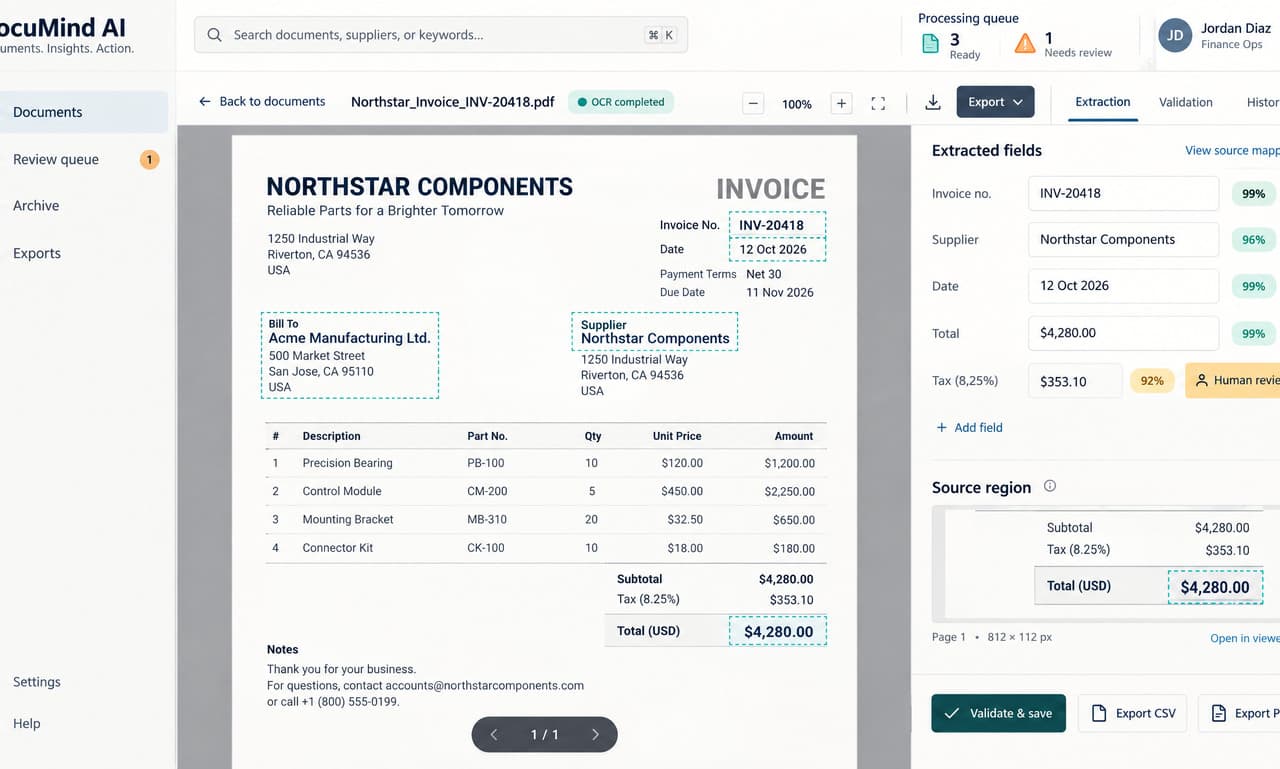
DocuMind AI is a product concept for an intake-to-validation workspace. New files enter a processing queue, extraction populates a structured field panel and source highlights help reviewers verify each value. Uncertain or contradictory fields remain in a human-review state. Once approved, records can be exported to an authorized downstream system with an audit trail. The interface emphasizes evidence and correction rather than claiming perfect extraction.
Key Features
Document intake queue
Track received, processing, ready and exception states.
PDF and scan preview
Keep the source visible beside extracted fields.
Field-level confidence
Prioritize uncertain values for human validation.
Source-linked evidence
Navigate from a field to its page and text region.
Review and correction controls
Allow authorized staff to correct and approve a record.
Searchable archive
Find documents by supplier, date, amount or document type.
Controlled export
Send approved, validated fields to a configured destination.
Architecture
Proposed architecture: browser UI for upload and review; API services for tenant, document, extraction and approval state; encrypted object storage for originals; PostgreSQL for metadata and extracted values; a job queue for OCR, layout parsing and extraction; and a model gateway with structured output validation. A search index can support archive lookup. External storage or accounting integrations should use least-privilege service credentials. Tenant isolation, document-level access control, retention policies and immutable approval events should be designed before deployment.
AI Implementation
OCR or vision models can identify text and layout; a language model can map candidate values into a schema and classify document type. Outputs must be type-checked, validated against arithmetic and format rules, and attached to page/region evidence. Confidence thresholds route uncertain fields to human review. The AI must not be the authority for payment approval or contractual interpretation; deterministic checks and authorized staff make those decisions.
Example Workflow
An operations user uploads a supplier invoice. The system creates a processing job, extracts candidate invoice number, supplier, date and total, and displays them next to the PDF. A total field with inconsistent tax arithmetic is flagged for review with its source region. The reviewer corrects the value, approves the record and exports it to a connected finance workflow. The original, extraction version and approval event remain linked.
Security & Privacy
Encrypt documents in transit and at rest; use tenant-scoped storage paths, short-lived access links and role-based permissions. Define retention and deletion schedules by document class. Scan uploads for malware and restrict file types and size. Avoid placing full documents in general logs; keep model data processing and retention terms explicit. Validate schemas and export permissions, and use retries that do not duplicate downstream records.
Business Value
The intended value is less rekeying for repeatable documents and a more traceable route to validated business data. Review queues focus human attention on fields that need it, while archive search can reduce time spent locating prior documents. No extraction accuracy, processing speed or savings are asserted.
Challenges & Approach
Anticipated issues include skewed scans, multiple invoice templates, currency/date ambiguity, handwriting, document versioning and sensitive personal information. Proposed decisions include page-level provenance, document-type-specific schemas, normalization with locale settings, uncertainty queues and redacted evaluation datasets.
Next Steps
Collect representative, permissioned sample documents; define schemas and acceptable validation rules; benchmark extraction by field and document type; test reviewer corrections and audit history; then verify retention, access and export controls before a limited workflow pilot.
Let's discuss your AI project
Thinking about a similar system? We can help you design, validate and build it.