
04 / AI PROJECT CONCEPT
FlowDesk AI
Customer conversations, connected.
FlowDesk AI: Business Messaging Inbox and Automation
The Problem
Teams can miss enquiries when conversations are split across personal devices, inboxes and spreadsheets. Repetitive questions invite automation, but an unguarded bot can send the wrong answer, expose data or trap customers in a loop. A workable system needs consent-aware outreach, queue ownership, escalation and observable automation behavior.
The Solution
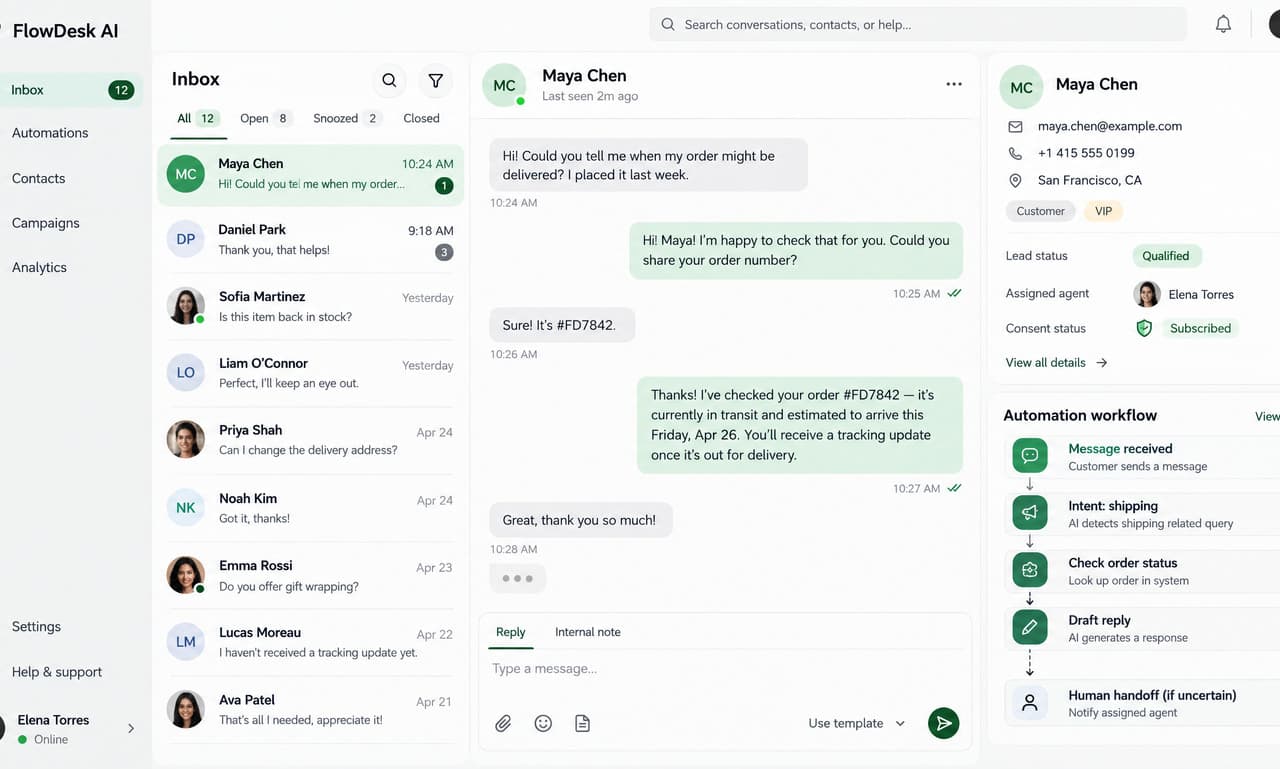
FlowDesk AI is a proposed shared inbox and workflow product. Agents work in one conversation queue with contact context, assignment and lead status. Administrators build event-driven automation from triggers, conditions and actions, then review a test run before activation. AI can classify intent and draft responses; a human takes over whenever confidence, policy or customer preference requires it. Channel logos and partner status are intentionally not asserted.
Key Features
Unified conversation queue
Give agents ownership, priority and state across configured channels.
Lead qualification stages
Capture structured intent and route it to the appropriate team.
Visual automation builder
Connect trigger, condition, AI step, business action and fallback nodes.
Consent-aware segments
Filter audience lists by approved communication preferences.
Human assignment and takeover
Make the responsible agent and transfer state visible.
Template and notification controls
Manage approved outbound messages and policy checks.
Run history and delivery analytics
Inspect execution state, errors, handoff rates and channel response outcomes.
Architecture
Proposed architecture: web inbox using WebSockets or server-sent events; backend conversation, contact, assignment and workflow APIs; PostgreSQL for durable message metadata and workflow state; encrypted object storage only where attachments are retained; queue workers for webhook delivery, retries and scheduled notifications; and per-channel adapters using documented APIs. AI orchestration is a bounded service for intent classification and draft generation. Store integration credentials in a managed secret vault, enforce tenant-scoped authorization, and include idempotency keys for inbound and outbound events.
AI Implementation
Language models can classify an inbound message into an allowed intent set, summarize a thread for the next agent and draft a response from approved business content. The model does not decide consent, send prohibited campaigns, mark a lead as qualified without configured criteria, or trigger sensitive account changes. Those actions use deterministic rules, explicit channel permissions and, where configured, a human approval step.
Example Workflow
A customer sends a delivery question through a connected business messaging channel. A webhook creates a conversation event; the workflow checks consent and classifies intent as shipping. A deterministic integration retrieves the allowed order status, then the assistant drafts a short reply using approved language. If the order lookup fails or the customer asks for a refund, the system assigns the case to a human and shares the relevant context. The agent reviews and sends the response.
Security & Privacy
Validate webhook signatures, encrypt channel tokens, segregate tenant data and verify opt-in/opt-out status before outbound sends. Apply retention controls to messages and attachments; redact payment details and credentials from logs. Ensure agent roles determine which queues and contact fields are visible. Build dead-letter queues, bounded retries, delivery deduplication, alerting and human override. All integrations and channel-specific constraints require implementation and testing.
Business Value
The intended value is fewer missed conversations, more consistent routing and a shorter path from common question to the right owner. Managers can see where automations fail or hand off instead of treating a bot as a black box. This concept makes no claims about response-time improvement, conversion or live channel integrations.
Challenges & Approach
Anticipated risks include duplicate webhooks, out-of-order events, channel rate limits, opt-in rules, multilingual intent ambiguity and customers needing immediate human support. Proposed decisions include idempotent event handling, explicit consent gates, retry visibility, constrained intent classes and an always-available takeover route.
Next Steps
Select one messaging provider and use case; map consent and data retention requirements; test webhook replay and duplicate events; evaluate intent classification across real anonymized examples; and pilot with human approval enabled before considering automation expansion.
Let's discuss your AI project
Thinking about a similar system? We can help you design, validate and build it.