
08 / AI PROJECT CONCEPT
KnowledgeOS
Answers grounded in company sources.
KnowledgeOS: Permission-Aware Internal Knowledge Assistant
The Problem
Employees may not know which document is current or where an answer is written. Keyword search can miss relevant wording, while a generic chatbot can generate unsupported answers or expose restricted content. The solution needs source citations, document freshness and permission-aware retrieval at the point of search.
The Solution
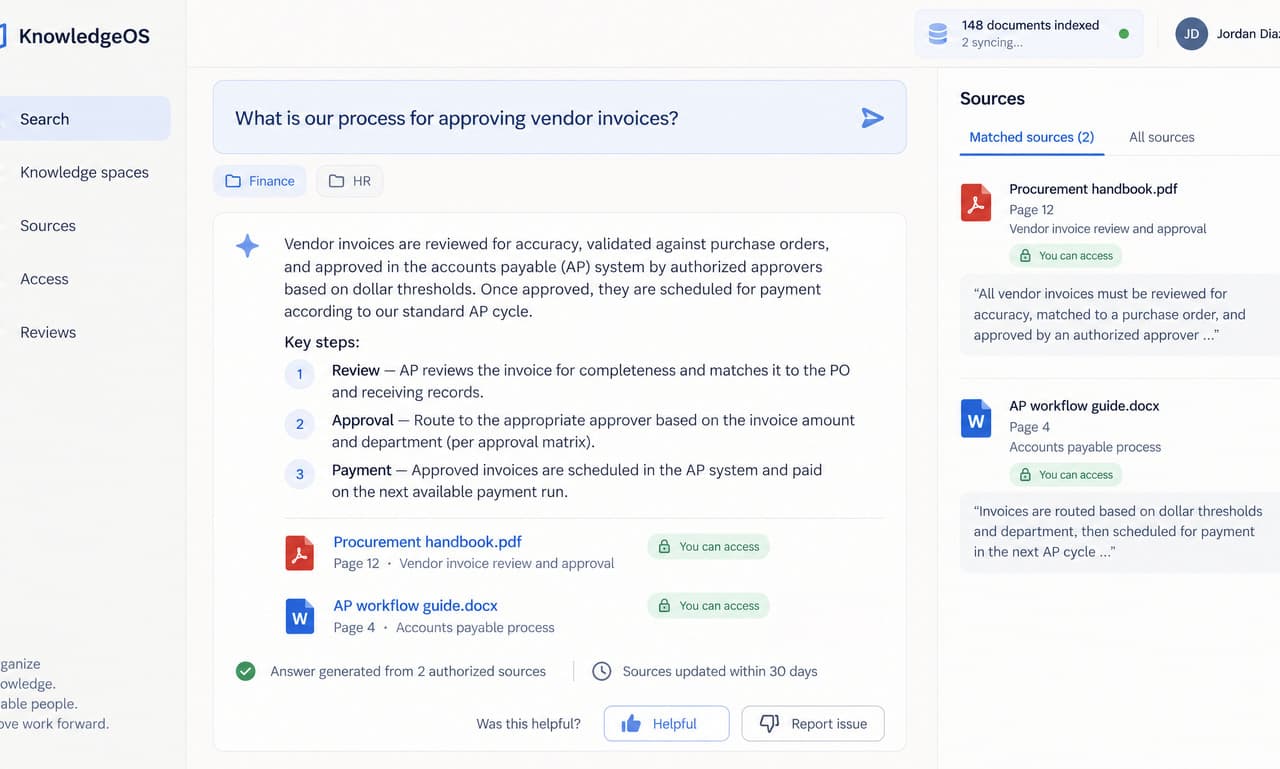
KnowledgeOS is a product concept for conversational search over curated company knowledge spaces. The user asks a question, the retrieval layer searches only documents the user can access, and the assistant returns a concise answer with source names, page or section references and feedback controls. Ingestion status and review states make it clear when documents are still processing or out of date. If evidence is insufficient, the product should say so and offer the relevant search results rather than inventing a policy.
Key Features
Conversational search
Ask practical questions in natural language across authorized content.
Source citations
Show document name, section/page and links near each claim.
Knowledge spaces
Separate HR, Finance, Engineering and other controlled collections.
Permission-aware retrieval
Apply existing access controls before a document enters model context.
Ingestion and freshness status
Expose indexing progress, failures and document version dates.
Answer feedback and review
Let users report stale or unsupported answers for correction.
Source-level management
Manage ownership, retention and access for indexed materials.
Architecture
Proposed architecture: authenticated web app; ingestion workers for approved file stores; object metadata and document versions in PostgreSQL; encrypted source storage where needed; chunking and embedding pipeline; vector search with tenant and ACL filters; and a retrieval-augmented generation service that receives only permitted passages. Integrations should use scoped OAuth credentials and a permission synchronization strategy. Identity and membership should flow from an organization identity provider, with explicit index deletion when source access is revoked.
AI Implementation
Embeddings support semantic retrieval; a language model synthesizes an answer from retrieved passages and cites those sources. A validator checks that citations refer to retrieved material and that the answer is not empty of evidence. Retrieval must enforce permissions before generation; citations do not by themselves solve access control. Deterministic ingestion state, version tracking, access checks and deletion propagation are essential non-AI logic.
Example Workflow
An employee asks how vendor invoices are approved. The app checks their current knowledge-space permissions, searches approved finance documents and returns a brief answer referencing the procurement handbook and AP workflow guide. The employee opens the cited sections and flags one outdated passage. A knowledge owner reviews the source, updates the document and checks the re-index status. If no relevant source exists, the assistant abstains and presents the nearest search results.
Security & Privacy
Synchronize ACLs and group membership; filter retrieval by tenant, space and user permissions; prevent cross-tenant vector queries; protect source files and integration credentials; and audit indexing, permission changes and answer feedback. Test revocation propagation, prompt injection in documents, citation validity, stale-source behavior and deletion. Minimize retained prompts and avoid exposing hidden system context in responses.
Business Value
The intended value is faster discovery of internal procedures and more confidence about where an answer came from. Knowledge owners gain visibility into indexing gaps and repeated unresolved questions. No answer accuracy, time savings or employee adoption results are claimed.
Challenges & Approach
Anticipated issues include access-control drift, duplicate or outdated copies, retrieval misses, prompt injection in source documents and citations that do not substantiate a generated statement. The proposed response combines ACL-aware retrieval, version metadata, source previews, adversarial evaluation and abstention when evidence is weak.
Next Steps
Select a small, permissioned document collection; map identity groups to knowledge spaces; create an evaluation set with answerable and unanswerable questions; test permission revocation and citation support; then add connectors one at a time with retention and deletion behavior documented.
Let's discuss your AI project
Thinking about a similar system? We can help you design, validate and build it.