
07 / AI PROJECT CONCEPT
LedgerIQ
Turn business data into decisions.
LedgerIQ: Explainable Finance and Operations Analysis
The Problem
A chart can reveal a movement but not its underlying transactions or operational context. Teams often export data into spreadsheets, build one-off reports and manually reconcile anomalies. Finance answers must preserve accounting definitions, source records and approval controls; a fluent narrative without traceability is not enough.
The Solution
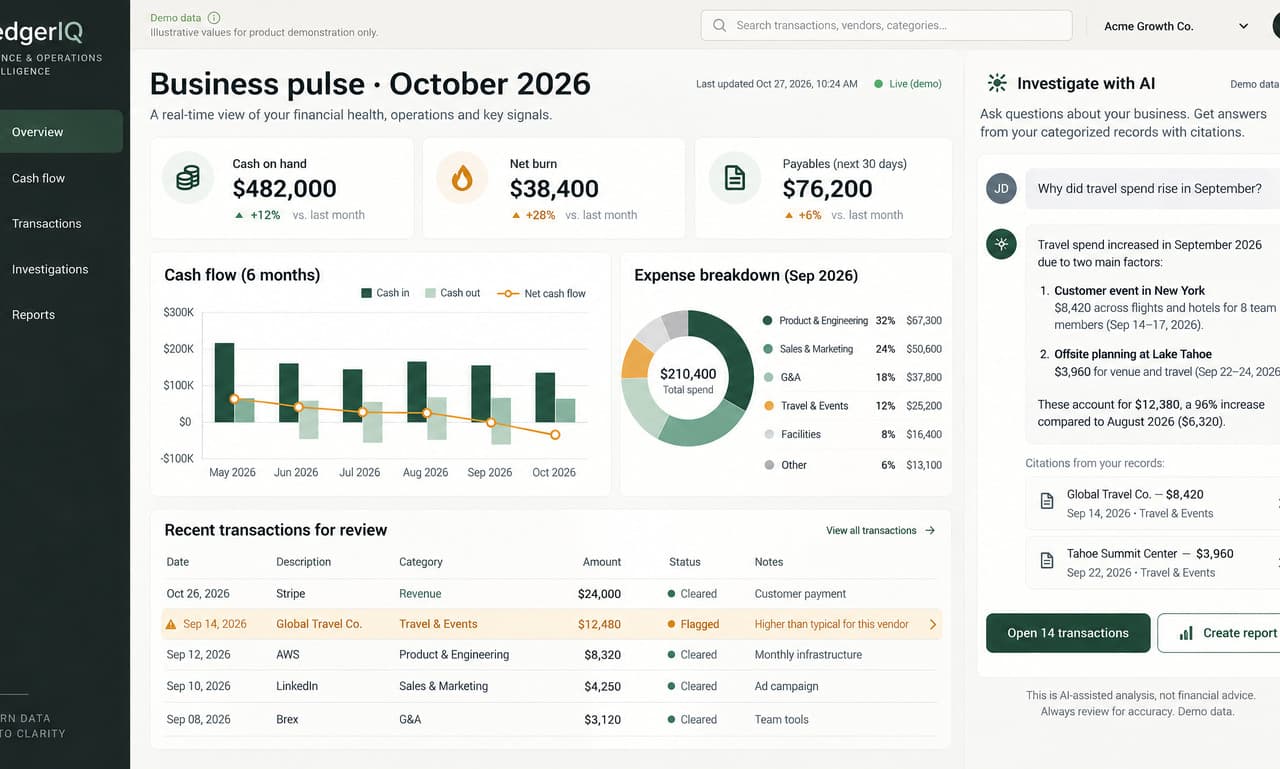
LedgerIQ is a product concept that pairs conventional finance dashboards with a natural-language investigation panel. Users review cash-flow and category summaries, inspect the underlying transaction rows and ask questions such as why a cost category changed. Responses point to matched records and reporting periods. Classification suggestions and anomaly flags remain review items; the product does not post journals or alter a ledger autonomously.
Key Features
Cash-flow overview
Show period-bounded inflows, outflows and balances with clear metric definitions.
Expense categories
Explore categorized spend and identify uncategorized transactions.
Transaction review
Filter and inspect source rows with date, account and memo context.
Natural-language investigation
Ask a question and receive a traceable summary of relevant records.
Anomaly review queue
Surface unusual values for investigation without labeling them fraud.
Reconciliation workflow
Track matched, unmatched and reviewer-approved items.
Management report export
Generate a dated report with data provenance and definitions.
Architecture
Proposed architecture: a finance-oriented TypeScript web client; ingestion services for authorized accounting exports or APIs; a normalized transaction store in PostgreSQL or a warehouse; a semantic metric layer defining period, currency and category calculations; and a language-model service that translates questions into constrained queries against approved views. Results should be grounded in aggregate query outputs and linked transaction IDs. Use role-based access, tenant isolation, encryption and immutable audit events. Never pass arbitrary SQL generated by a model directly to production data.
AI Implementation
AI can map natural language to a small, approved set of metric queries, explain differences between periods, suggest categories and summarize anomalies with supporting rows. Deterministic accounting logic owns totals, currency conversion, period boundaries, reconciliation state and journal posting. The system must show formulas and sources, identify missing data, and require a qualified user to approve any accounting change.
Example Workflow
A finance lead notices travel spend increased in September. They ask LedgerIQ for an explanation. The query router selects an approved category and time-period comparison, retrieves totals and the 14 relevant transactions, then generates a short summary with links. The user opens the transaction list, corrects a misclassified item through the standard review control and exports a dated management note. The AI did not change the books.
Security & Privacy
Use read-only credentials for initial integrations, tenant-scoped queries, field-level controls for bank details and PII, encrypted secrets and auditable exports. Enforce query limits and validate all model-selected dimensions and periods against the semantic layer. Redact account identifiers in logs, flag stale syncs and handle provider outages without fabricating current balances. Privileged changes require explicit user confirmation and audit records.
Business Value
The design aims to make financial questions easier to investigate by connecting summaries to underlying records. It can organize review and help managers produce consistent, source-aware explanations. No forecast accuracy, accounting compliance or financial improvement is claimed.
Challenges & Approach
Anticipated problems include inconsistent category mappings, fiscal calendars, currencies, duplicate imports and ambiguous questions. The proposed approach is a governed metric layer, visible data freshness, explicit currency and period labels, deduplication keys, and follow-up prompts when the question lacks scope.
Next Steps
Agree on one source system and a chart of accounts; define core metric semantics with a finance professional; create reconciliation and anomaly test fixtures; validate natural-language queries against expected results; and perform a security review before enabling write scopes.
Let's discuss your AI project
Thinking about a similar system? We can help you design, validate and build it.