
02 / AI PROJECT CONCEPT
OfficeSight
See what your workplace needs.
OfficeSight: Edge-Based Workplace Occupancy Intelligence
The Problem
Facilities teams may have cameras and local network video sources but lack a clear operational view of occupancy by zone, connected-device status and relevant events. A cloud dashboard that proxies video can increase bandwidth and privacy exposure. Individual employee monitoring is not the intended value here; aggregate occupancy and on-site processing are the design center.
The Solution
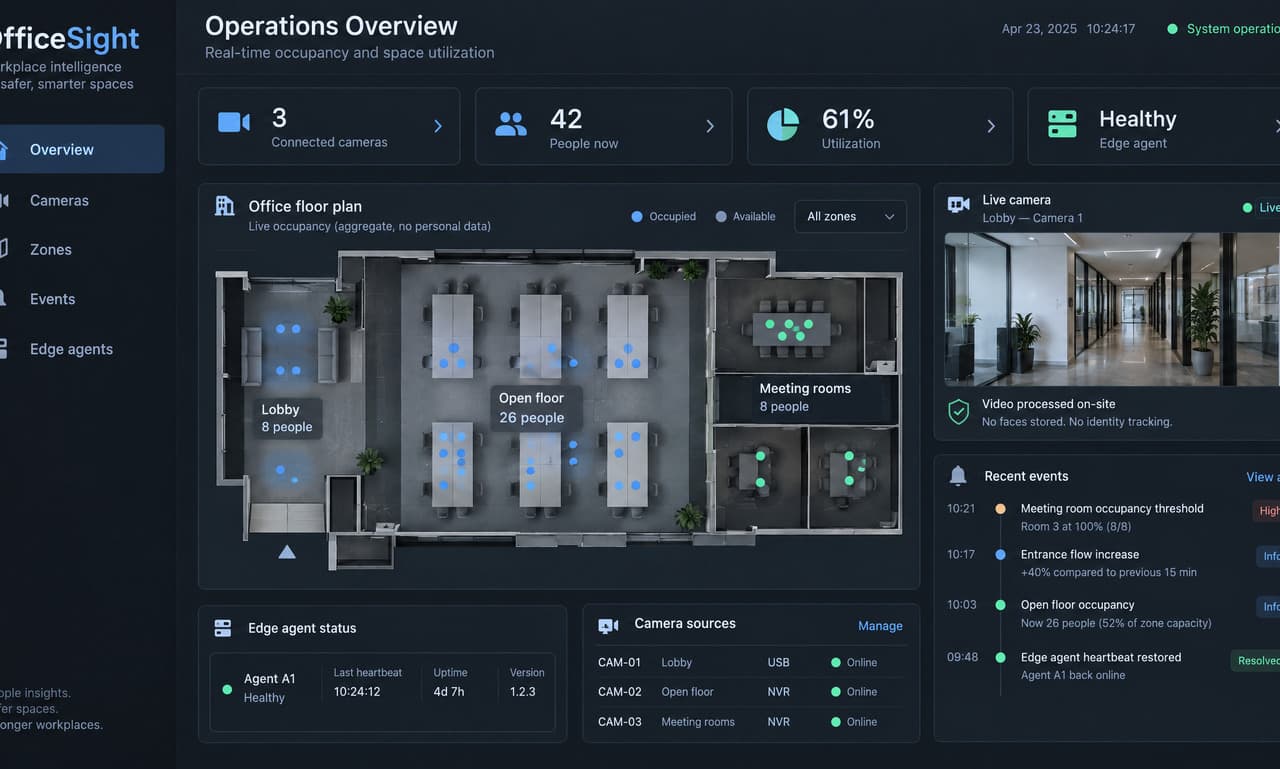
OfficeSight is an existing Komyosys product reference with a publicly described hosted frontend, Supabase authentication/organization controls, a public control-plane API and a Windows customer-site Edge Agent. The public page says the edge runtime handles camera sources, YOLO person detection, ByteTrack tracking, frames, recordings and occupancy locally; the control plane handles accounts, membership, pairing and heartbeat rather than proxying live video. The portfolio image is a visual concept, not a verified screenshot of the running app. The concept interface emphasizes zones, aggregate occupancy, camera status, events and local-processing disclosure.
Key Features
Zone occupancy view
Show aggregate counts by lobby, open floor and meeting areas without naming individuals.
Camera and source status
Distinguish configured USB/NVR sources and detection versus monitoring roles.
Local Edge Agent health
Surface pairing, heartbeat and runtime health without implying cloud video relay.
Operational event timeline
Review occupancy thresholds and device events with timestamps.
Utilization trends
Compare aggregate zone activity over time for facilities planning.
Privacy-first interface cues
Make local processing and data boundaries visible in the operations console.
Role-aware organization access
Present organization membership and access boundaries in the hosted control plane.
Architecture
Verified public description: OfficeSight documents a hosted frontend on Vercel, Supabase authentication/organizations/memberships/RLS, a public HTTPS control-plane API, and a Windows OfficeSightEdgeAgent.exe on the customer site. The page describes YOLO detection and ByteTrack tracking on the local Edge Agent; it states that frames, detections, occupancy and recordings remain in the local runtime, while the control plane handles accounts, organization access, pairing and heartbeat rather than live video proxying. Agent credentials are described as hashed and unable to call user APIs. Proposed extensions for this concept include signed event summaries, configurable retention, secure update channels, device attestation and explicit aggregate export controls. Public descriptions are not an independent operational audit.
AI Implementation
The public product page specifically identifies YOLO person detection and ByteTrack tracking as Edge Agent functions. The dashboard can aggregate counts and summarize operational patterns; a language model is not required for basic counting, zone thresholds or device health. Any future AI summary should use approved aggregate event data, clearly indicate its time window, and avoid identity inference or employee-performance assessment. Camera ingestion, counting, thresholding and access decisions should remain explicit, testable runtime logic.
Example Workflow
A facilities operator signs in, selects a site, and checks the Edge Agent heartbeat. After the local health check succeeds, the interface displays aggregate occupancy for configured zones and status for detection or monitoring cameras. If a threshold is crossed, an event appears with a timestamp and affected zone. The operator checks the local camera view if authorized, records an operational action, and reviews aggregate utilization trends later. The described architecture keeps live frames on the customer-site runtime.
Security & Privacy
The public product page describes organization membership/RLS, local video processing, control-plane separation and hashed agent credentials. Those are public product statements, not externally verified test results. Production assurance should further verify camera-source authorization, local host hardening, certificate rotation, signed agent updates, network segmentation, retention settings, event redaction, access audit trails, recovery procedures and failure behavior during disconnection. A deployment review should confirm that no live frames cross the control plane and that all site roles are least-privileged.
Business Value
The intended value is clearer space utilization and device health for facilities decisions, with reduced reliance on manual headcounts and less need to centralize raw footage. Aggregated zone trends can inform room planning and operational response. No occupancy accuracy, cost savings or deployment outcome is claimed in this portfolio.
Challenges & Approach
Anticipated engineering risks include camera diversity, lighting and occlusion, edge-device resource limits, local network failure, tracking behavior across zones, and ensuring that aggregated metrics do not become an individual surveillance tool. The published design’s edge-first boundary is a strong architectural constraint; deployment-specific camera validation and privacy review remain necessary.
Next Steps
Confirm supported camera configurations and customer-site retention expectations; test edge performance on representative hardware and scenes; conduct a privacy and threat-model review; evaluate count quality by zone and conditions; and document the exact event schema, agent update process and offline/reconnect behavior.
Let's discuss your AI project
Thinking about a similar system? We can help you design, validate and build it.