
01 / AI PROJECT CONCEPT
PeopleOS AI
Your workforce, in focus.
AI-Powered HR Operations, Hiring and Workforce Insights
The Problem
Employee information often lives in separate spreadsheets, recruiting tools, calendars and payroll workflows. HR teams then reconcile the same facts repeatedly, while managers lack a clear view of hiring stages, attendance, leave and workforce changes. Sensitive employment decisions also require explainable policies and accountable human judgment; an AI-generated suggestion cannot become the decision-maker.
The Solution
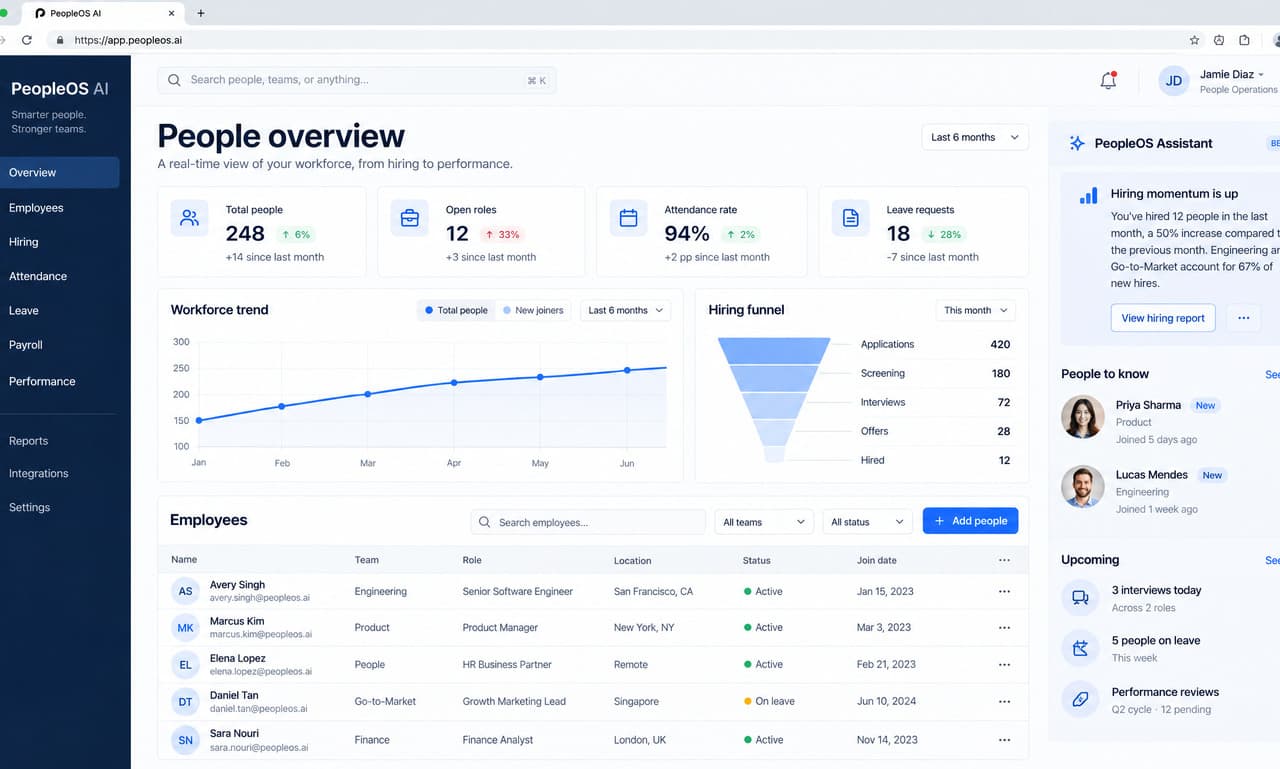
PeopleOS AI is a product concept for a coherent HR workspace that connects the employee lifecycle without hiding the underlying records. The overview brings hiring, workforce movement and attendance signals together. Recruiters can move candidates through a defined pipeline, HR staff can validate leave and employee records, and managers can ask a permission-aware assistant to summarize approved workforce data. Payroll is presented as a review workflow, not an unverified payment engine.
Key Features
Employee directory and org structure
Keep role, team, manager and employment status discoverable in one access-controlled record.
Recruiting pipeline
Track candidates by stage and preserve recruiter notes and next actions.
Attendance and leave review
Surface requests and exceptions for policy-aware staff review.
Payroll preparation workspace
Organize changes and approvals before export to an authorized payroll system.
Workforce trend summaries
Explain trends from approved, aggregated HR data with links back to source records.
HR assistant with citations
Answer policy and process questions from current, approved employee handbooks.
Audit-friendly decision history
Record who reviewed sensitive changes and what source informed the action.
Architecture
Proposed architecture: a TypeScript web client with accessible employee and manager views; a tenant-aware API layer for employee, leave, recruiting and audit services; PostgreSQL for structured HR records; object storage for protected documents; a queue for notifications and scheduled summaries; and an AI orchestration service that retrieves only authorized policy content. Integrations with an HRIS, identity provider and payroll vendor would be scoped and tested per customer before being represented as live. Use SSO/OIDC, role-based access controls, organization-scoped authorization and encryption with managed secrets. Monitoring should include API traces, queue health, model-call latency and redacted error logs.
AI Implementation
AI can draft job-description variants, classify inbound applications against explicitly configured criteria, summarize aggregate workforce trends and retrieve answers from approved policy documents. Candidate screening must expose the criteria and source data; it should assist review, not make hiring decisions. Payroll calculations, leave entitlements, employee-status changes and permissions stay in deterministic business rules with human approval. Sensitive fields must be excluded from model context unless their use is expressly authorized.
Example Workflow
An HR manager opens the overview and sees two leave requests and a hiring-stage backlog. They open the recruiting pipeline, review a candidate profile and compare its cited qualifications with the role criteria. Separately, a manager asks whether a policy permits a particular leave type; the assistant returns a concise answer linked to the current handbook section. The manager submits a request, the policy engine checks eligibility, and an authorized HR reviewer approves or rejects it. The event is logged; nothing is silently changed by the model.
Security & Privacy
HR data is sensitive by default. Proposed controls include tenant-scoped database policies, least-privilege roles, field-level restrictions for compensation and performance information, short-lived signed document links, encrypted integration credentials, and explicit audit events for reads and changes. AI retrieval should enforce the same permissions as the user and return source references. Add validation and human review for employment-impacting actions, idempotent workflow handling, backup and restore tests, rate limits, and an incident response plan. These are design requirements, not claims of deployed controls.
Business Value
The intended value is fewer duplicate updates, faster retrieval of current people information and clearer ownership of routine HR decisions. A shared status view can help HR teams spot stalled hiring or pending leave approvals earlier. No time savings, hiring outcomes or payroll accuracy results are claimed; the design would need customer workflow testing and operational measurement.
Challenges & Approach
Anticipated challenges include inconsistent employee records, different country-specific employment rules, permission boundaries across managers and HR, and bias risk in candidate support. The proposed response is explicit source-of-truth mapping, jurisdiction-specific policy configuration, deny-by-default access, transparent criteria and a human decision gate. Payroll integrations should be treated as a separate, audited boundary.
Next Steps
Validate data ownership and permission models with a representative HR team; prototype one region and one authoritative employee source; run usability and accessibility sessions; create evaluation cases for policy retrieval and candidate summaries; then implement a sandbox payroll export and security review before any production pilot.
Let's discuss your AI project
Thinking about a similar system? We can help you design, validate and build it.